
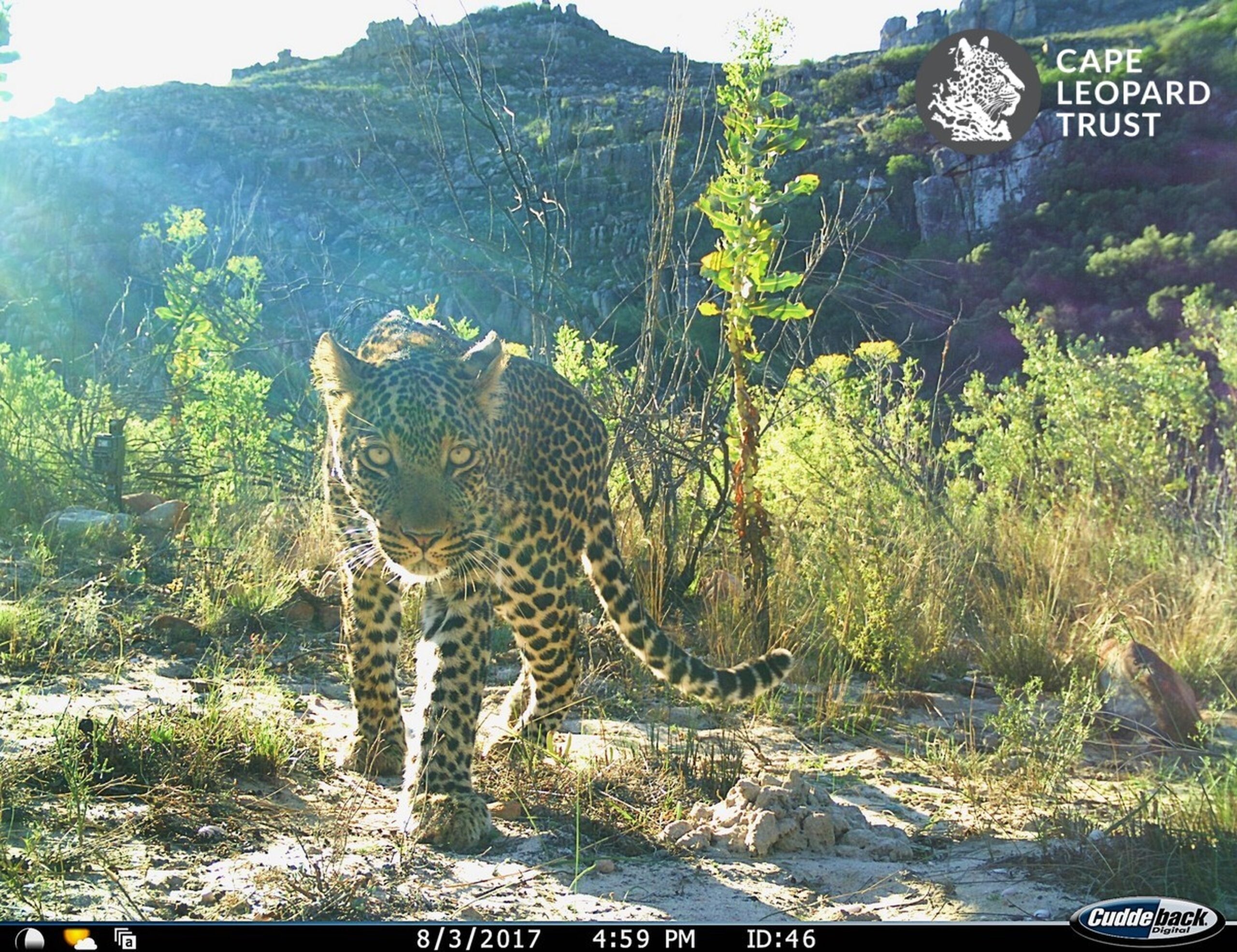
High on the granite slopes of the Simonsberg Mountain, above rows of vines tended for generations, something extraordinary moves through the fynbos at night. The leopard — secretive, solitary, and perfectly adapted to rugged terrain — is one of South Africa’s most elusive predators. In the Cape Winelands, winemakers and private landowners are among its most committed champions, aiding the efforts of dedicated conservation organisations.
Among them is Nora Thiel, Executive Director of Delheim Wine Estate in Stellenbosch and chair of the Greater Simonsberg Conservancy (GSC). For Nora and Delheim, conservation is woven into the very fabric of how the farm operates. “Being part of the Greater Simonsberg Conservancy allows us to contribute to conservation beyond our farm boundaries,” she says. “We are but custodians for the region’s future farmers.”
A Mountain Full of Secrets
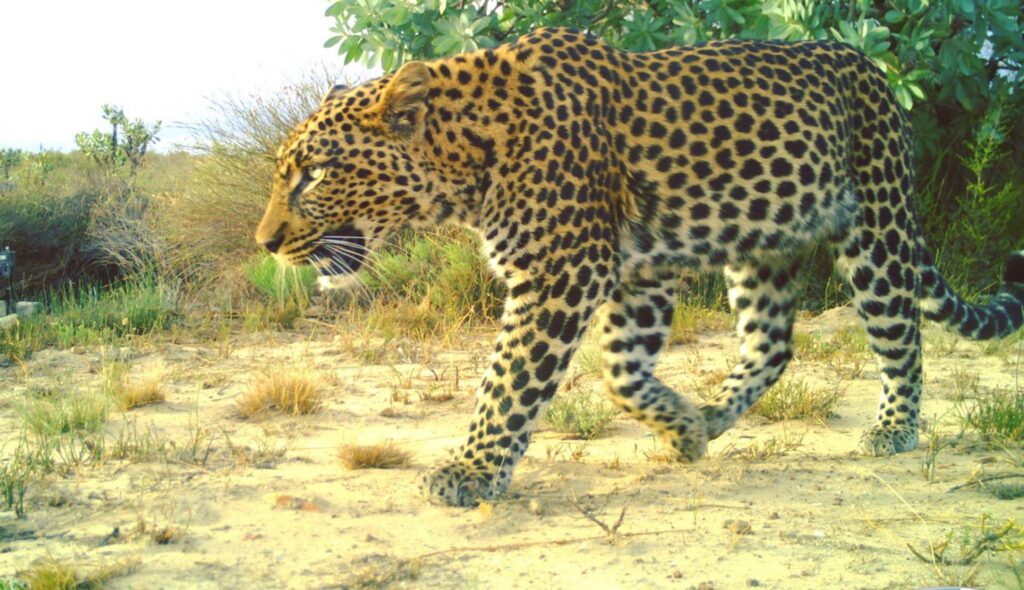
Leopards occur all along the mountainous regions of the Cape Fold Belt in the Western, Eastern and Northern Cape. Cape leopards are physically smaller than their savannah cousins and highly adapted to the rocky terrain and dense fynbos of ranges like the Boland Mountain Complex, of which Simonsberg forms part. They are under pressure — from habitat loss, human-wildlife conflict, and illegal snaring — and their exact numbers remain uncertain.
That uncertainty is precisely what the Cape Leopard Trust (CLT) set out to address. Between 2010 and 2012, the CLT conducted the first intensive large-scale survey of leopards in the Boland Mountain Complex, establishing a critical population baseline across some 2 500 square kilometres. More than a decade later, the CLT returned for a comprehensive re-survey. The results were both reassuring and sobering: leopards are still there, their territories overlapping with farm boundaries, hiking trails, and wine estates.
Where Wine Country Meets Wild Country
Camera traps deployed across GSC member properties — including Boschendal, Plaisir, and Delheim — captured photographic evidence of leopard presence along the Simonsberg slopes, confirming that the mountains above the vineyards continue to serve as vital ecological corridors. Over fifteen years, the CLT has monitored multiple leopards whose territories overlap with Conservancy landholdings.
“The Greater Simonsberg Conservancy is built on the belief that meaningful conservation happens when landowners work together at a landscape level,” says Nora. “The presence of leopards in the broader Simonsberg area is a powerful reminder of why sustainable land management matters.” In 2025, the GSC demonstrated that commitment by donating R50 000 to the CLT — funds raised at the Absa Cape Epic MTB event — to support research, conservation, and education initiatives.
Protecting Leopards in the Winelands
Protecting leopards is not only about camera traps and corridors. One of the most pressing threats in the region is illegal snaring, which indiscriminately traps predators and prey alike. In 2023, the CLT launched its Snare Free Hotline and began facilitating awareness workshops for GSC members — a practical intervention aimed at changing behaviour on the ground, one farm at a time. The CLT’s education team has also run eco-club lessons, school presentations, and educational outings, bringing young people into the conversation about coexistence. Conservation, after all, is generational work.
Perhaps the most innovative initiative is the Mobi-kraal project — affordable, mobile predator-proof livestock enclosures that reduce the incentive for retaliatory killing of leopards. In 2025, Boschendal became the first GSC property to receive a prototype. The message is clear: with the right tools and partnerships, agriculture and conservation do not have to be in conflict.
A Model for the Future
What Delheim and the Greater Simonsberg Conservancy represent is a model worth paying attention to. In a country where conservation budgets are stretched and wild habitat is under constant pressure, the engagement of private landowners — winegrowers, farmers, and estate managers — may be among the most powerful tools available. Camera traps on wine farms. Fundraising at cycling events. Hiking trails that raise money for leopard research. These are not small gestures — they are part of a coherent, landscape-level approach to keeping a magnificent predator alive in one of the world’s most celebrated wine regions.
The Cape leopard does not know that it lives above some of the world’s finest Chenin Blanc and Cabernet Sauvignon vines. But for those who tend those vines — and who look up at the Simonsberg with a sense of responsibility for what moves through it — that proximity feels like both a privilege and an obligation. Nora Thiel and Delheim are making sure that obligation is honoured.
Walk for the Wild | 9 May 2026
Delheim Hiking Trail, Stellenbosch | 10km | R450pp
On 9 May 2026, Delheim Wine Estate will open its mountain trails for the inaugural Walk for the Wild — a fundraising event in support of the Cape Leopard Trust and the Simonsberg Conservancy. The 10-kilometre route offers sweeping views over the Stellenbosch valley. Trail runners start at 08h00; hikers enjoy a rolling start between 08h00 and 10h00. Tickets are R450 per person, bookable via Quicket. It is a chance to walk through leopard country with purpose and contribute directly to their protection.
Book via Quicket: https://www.quicket.co.za/events/166878-walk-for-the-wild-delheim-wine-estate/
Text: Editorial Desk | Images: CLT / Delheim