
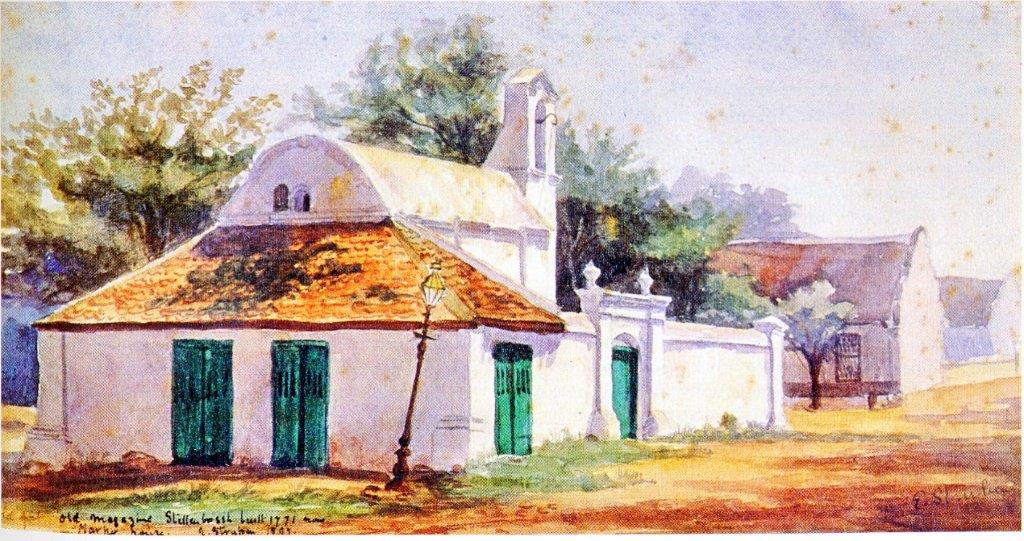
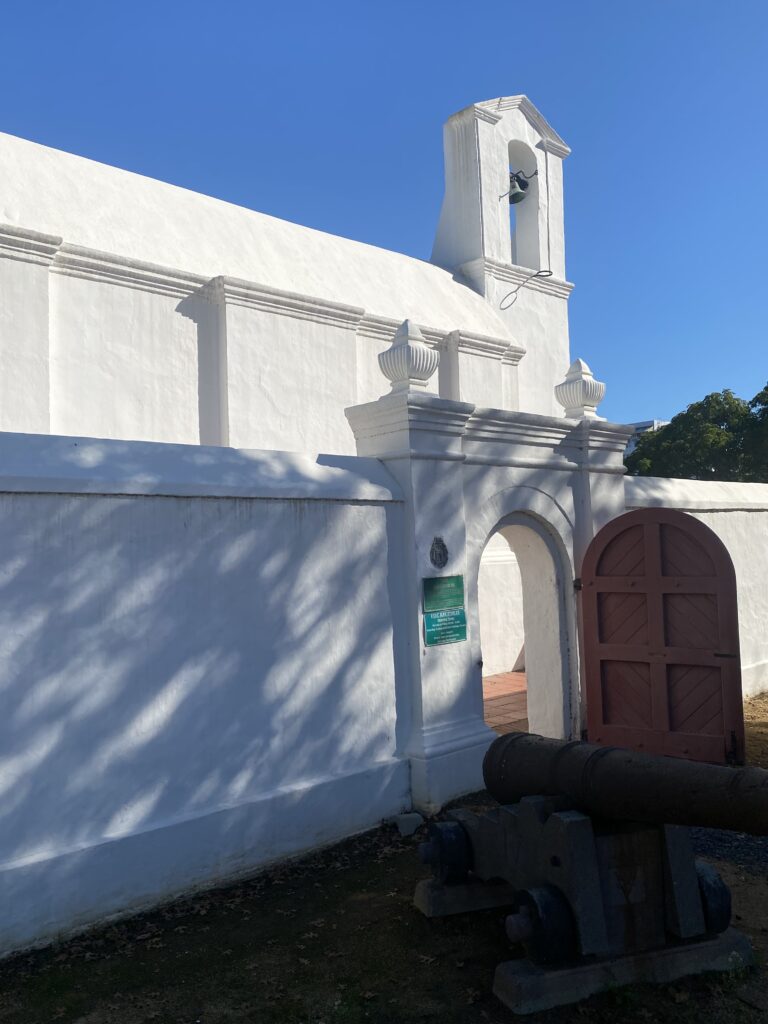
The piquant little building just below the Braak – complete with its own island at the top of Market Street – should only have housed a bordello at some point to have literally seen everything in Stellenbosch’s three-and-a-half centuries. If it had not been for the two cannons at the door, one would be forgiven for not noticing the structure at all. But Kruithuis – or the Powder House – as it’s been known since the earliest times, is not uninteresting at all.
The very first civil commando’s in Stellenbosch were launched in 1685, and every male free citizen was called up. They were organized in mounted and infantry units that had to report to the Cape each year for military training. Every man who could handle a gun had to make himself available on short notice to defend the town and the Cape in case of an attack. In 1703 the military exercises for the Stellenbosch and Drakenstein units were moved to the Braak. But the arsenal of the VOC remained in the Cape, and once a year gun powder, lead bullets and flintstones were delivered to Stellenbosch.
For nearly a 100 years it was plotted and planned and mumbled to have an arsenal established in Stellenbosch, but – just like today – the burocracy wasn’t easy to move. Finally, in 1776, approval was granted for the town to build its own powder house, and it went out on tender. Philip Hartog and Lambert Fick were appointed with the order to construct it as quickly and cheaply as possible.
Or course, the highly flammable and unstable ammunition had to be stored outside of the town, but preferably within sight, easy reach and close to a main road. It was decided the ideal place would be next to the Braak on Market Street, which also placed it in close proximity to the military exercise grounds. Building started in November 1776 and was completed ahead of schedule on May 5th, 1777. The letters VOC (Vereenigde Oost-Indische Compagnie) are visible on the gable, and right above it a C for Cabo, or Cape.
In Stellenbosch’s nearly 350 years, no shot was ever fired in war, and the Powder House quickly lost its usefulness. Within 70 years of its completion, the arsenal was gone. For almost a century that followed, it served as a fruit and vegetable storage facility for the Friday markets on the Braak. At one stage, it even housed the town’s fire brigade! Some stories would have it that it was also used as a slave market, but there’s no proof for that.
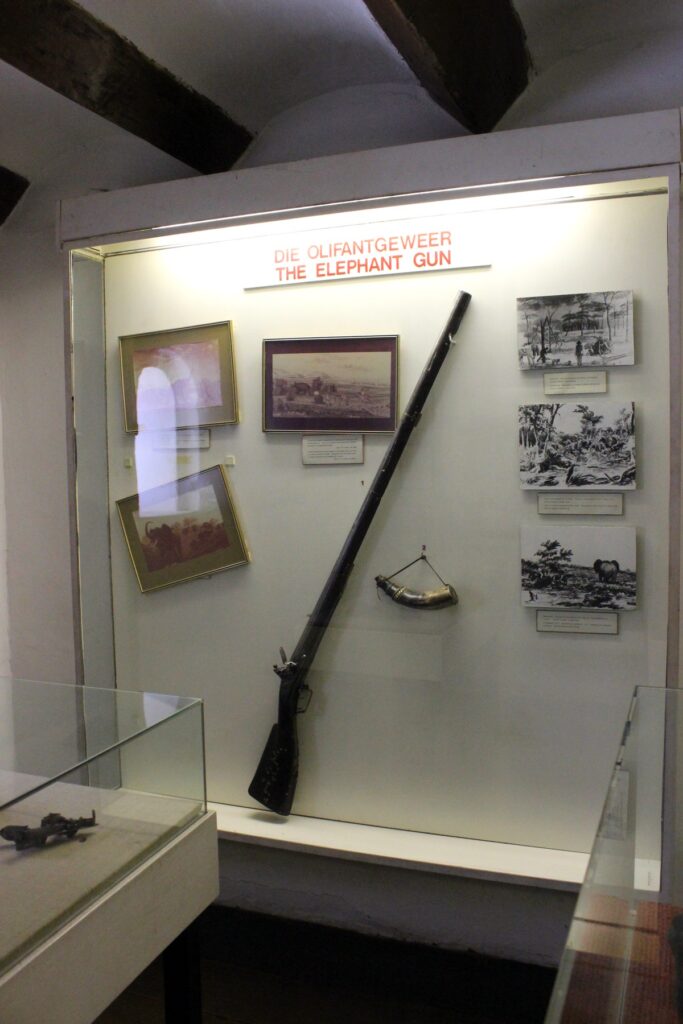
The Powder House underwent extensive restoration work in 1936, after which it was used for the exhibition of Africana, and then it laid empty for many year. Eventually, in 1971, the municipality decided to hand it over to the Town’s Museum, in whose custody it remains to this day.
But the most interesting fact about this structure is that, besides being the only one of its kind still standing in South Africa, it’s one of the very last in the world that would be recognizable to the VOC authorities. Therefor, this unique piece of architectural historicity is not only part of the story of Stellenbosch, but of an epoch that stretched from New York (that started out as a West Indian Company colony) to India and all the way to Indonesia.
Text: Eduan Naude | Images: Editorial Desk, Stellenbosch Museum, eGGSA