
Once upon a time, long, long ago, the town fathers saw the sun rise for the very first time… from an island! Simon van der Stel described the beautiful piece of land on which he camped — and which inspired him to establish the settlement of Stellenbosch — as “a small island, completely surrounded by fresh water.” Contrary to what many people assume, it was not merely a triangular patch of land where the Eerste River happened to have a side channel.
The 1710 map shows that there was indeed a real island in the Eerste River. The river split roughly at the old Agricultural Hall. The right-hand branch swung like a square corner at the top of what is today known as Dorp Street, right in front of Utopia, and flowed down along our Dorp Street. The furthest point of the island was more or less in line with the circle where the street now intersects with Piet Retief Street and the bridge to Paul Roos. From there, the two branches joined seamlessly and flowed on as one.
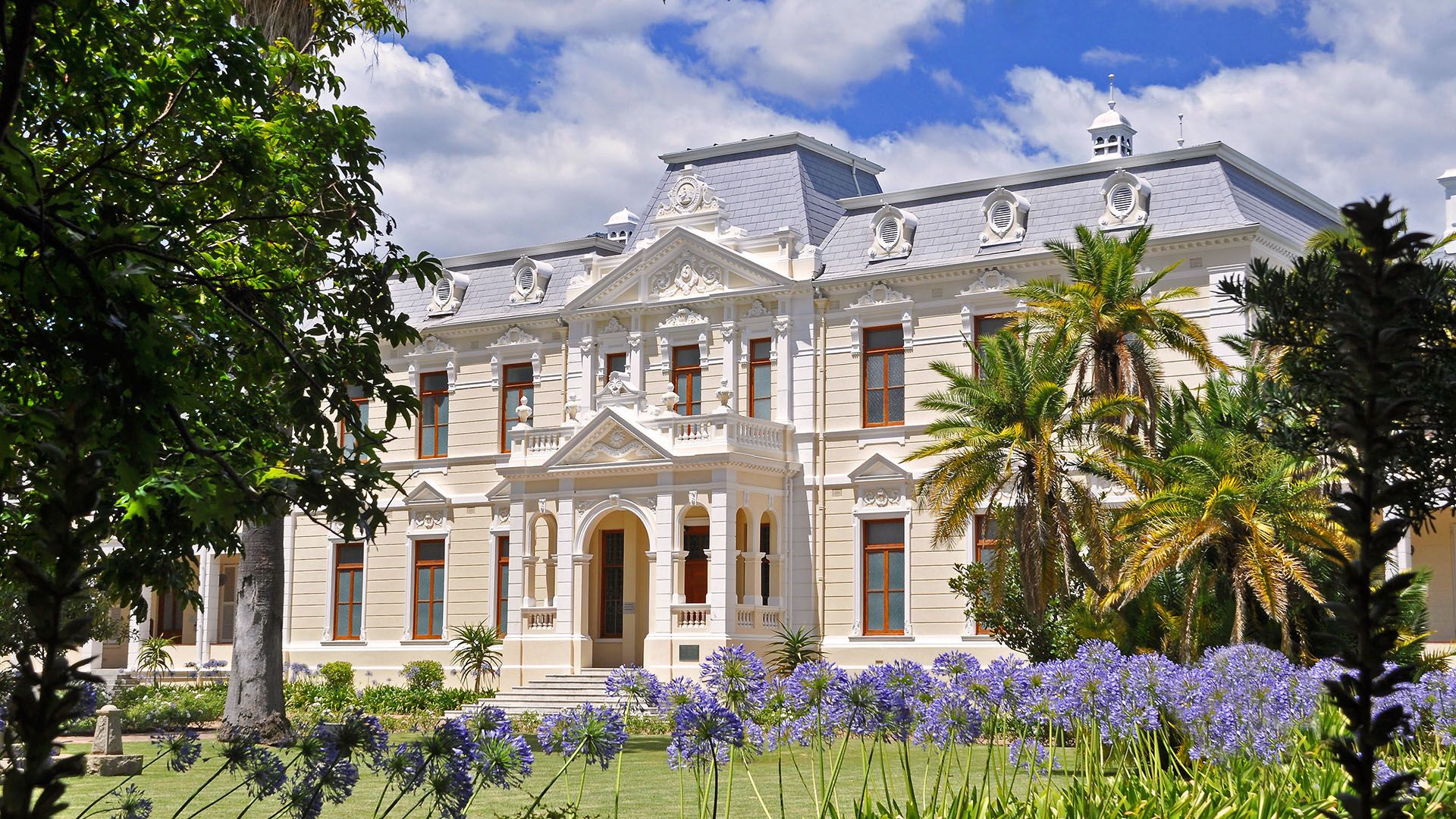
When Simon, on the recommendation of his friend Hendrik Adriaan van Rheede tot Drakenstein, upgraded the settlement to a full-fledged town (and thereby also transformed the refreshment station at the Cape into a full-fledged colony!), a church and a magistrate’s office had to be built. These ended up on opposite sides of the right-hand river branch… the church where the Oude Werf Hotel stands today, and for some reason the Drostdy was built on the island, where the Theological Seminary would later be. Perhaps Simon thought it fitting — a sort of monument on the spot where he had given life to Stellenbosch. But this was also the seed that would shorten the lovely island’s lifespan.
The Cape winter cared little for Dutch judicial authority. Every few years the Eerste River came down in fury and spilled over its banks. But the flood of the winter of 1768 washed away the bridge to the Drostdy and nearly cost the magistrate his life — and in those days he and his office were just as sacred as the minister and his church. Right then the island had to become part of the mainland.
The island vanished from the earth when it was decided to fill in the “Dorp Street branch” and to deepen, widen, and reinforce the other half south of the town with rocks. When the 1770 map of Stellenbosch was drawn up, the island was gone.
One can imagine what the French Huguenots in the neighbouring village — familiar with Paris’ historic Île de la Cité and its breathtaking Notre Dame cathedral — must have made of the commotion: “Mon Dieu, the Dutch and their fear of water! Imagine our Île being destroyed simply because the Seine sometimes overflows its banks. But that is the Dutch for you: draining water and creating land is a matter of honour.”
No one will ever know whether Simon could have prevented the destruction of his island, or whether he perhaps played a role in suppressing any such plans during his lifetime. It isn’t far-fetched, however, to imagine him turning in his grave when Operation Island Murder was underway.
Some historians have much sympathy for the old Stellenbosch residents — the river in flood did indeed cause major disruption at times. But was there really no better solution? Just imagine: a modern Eikestad that could boast not only its charm but also an island, with little bridges, trees, and footpaths along the water… Alas!
So let us think carefully whenever plans are made to tamper with what already exists. The future will judge decisions — and may deliver unforgiving verdicts on changes that fail the aesthetic test of time.
Text: Eduan N. Naudé | Image: Wikipedia